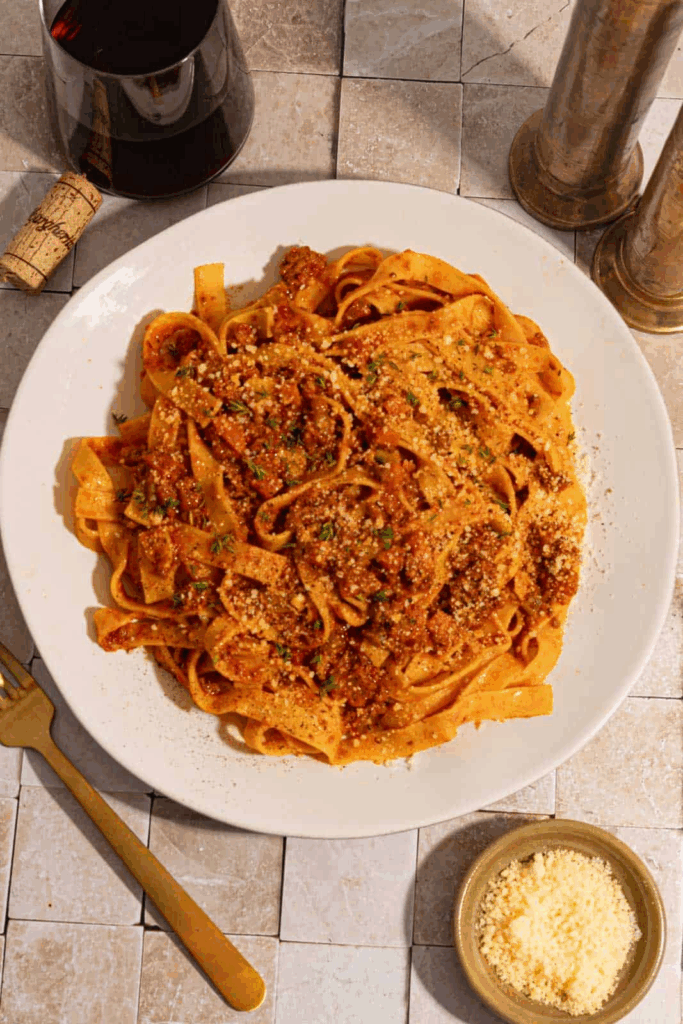
Let’s be clear: this is not a 30-minute “Bolognese.” This is a ragù. It’s a slow, gentle simmer that coaxes every last bit of flavor from a few humble ingredients. It’s the recipe I learned from a tiny, formidable nonna in Bologna who smacked my hand with a wooden spoon for trying to rush the soffritto. This sauce is a weekend project, a labor of love that fills your house with the most incredible aroma for hours. It’s my ultimate Sunday sauce.
Quick Look
| Prep | Cook | Total | Feeds | Level |
|---|---|---|---|---|
| 30 mins | 3+ hours | 3.5+ hours | 6-8 | Moderate |
Why You’ll Love This Recipe
- The depth of flavor is unreal—savory, rich, and subtly sweet.
- It freezes like a dream, so a little effort gives you future gifts.
- It’s a therapeutic, hands-off simmer that rewards your patience tenfold.
Grab These
- For the Soffritto: 1 large onion, 2 carrots, 2 celery stalks, all finely chopped. (A food processor makes this quick work.)
- 3 tablespoons olive oil
- 1 lb ground beef (80/20 chuck is perfect)
- 1 lb ground pork
- 4 oz pancetta, finely diced
- 1 cup dry red wine (a Chianti or Sangiovese is ideal)
- 1 cup whole milk
- 1 (28-oz) can whole San Marzano tomatoes, crushed by hand
- 2 cups chicken or beef stock
- The Aromatics: 1 bay leaf, a pinch of freshly grated nutmeg
- Salt and freshly ground black pepper
- 1 lb fresh tagliatelle or pappardelle (or a good dried brand)
- Freshly grated Parmigiano-Reggiano, for serving
Let’s Make It
This is where the magic starts. In a large, heavy pot (like a Dutch oven), heat the olive oil over medium-low heat. Add your onion, carrot, and celery (the soffritto) and a pinch of salt. Now, you must be patient. Cook this, stirring occasionally, for a good 15-20 minutes until the vegetables are soft, sweet, and translucent, but not browned. This is the foundation of your entire sauce. Don’t rush it.
Increase the heat to medium-high. Add the pancetta and cook for 2-3 minutes until it starts to render its fat. Then, add the ground beef and pork. Break it up with a spoon and cook, without stirring too much, until it’s well-browned. You want fond (those browned bits) on the bottom of the pot. This is flavor. Once browned, pour in the red wine. Let it bubble vigorously, scraping the bottom of the pot, until the wine is almost completely evaporated.
Now, lower the heat back to low. Stir in the milk and the pinch of nutmeg. Let it simmer gently, stirring, until the milk is mostly absorbed. This step is the real secret—it keeps the meat incredibly tender and adds a subtle sweetness. Then, add the hand-crushed tomatoes, the stock, and the bay leaf. Bring it to the barest whisper of a simmer. You should only see the occasional bubble break the surface.
Partially cover the pot and let it simmer for at least 3 hours, and preferably 4. Stir it every so often, and if it looks like it’s getting too thick, add a splash of water or more stock. You’re waiting for the fat to separate and float to the top in little orange pools. That’s when you know it’s ready. Season generously with salt and pepper at the very end.
When you’re ready to serve, cook your tagliatelle in well-salted water until al dente. Drain it, reserving a cup of pasta water. Add the pasta directly to the pot with the ragù and toss it with a splash of that starchy water over low heat for a minute, letting the pasta drink in the sauce. Serve immediately in warm bowls with a mountain of Parmigiano-Reggiano on top.
Nutritional Facts (Per Serving)
| Nutrient | Amount |
|---|---|
| Calories | ~ 620 kcal |
| Protein | 38g |
| Carbohydrates | 55g |
| Fat | 28g |
| Fiber | 4g |
| Sugar | 8g |
| Note: Values are estimates |
Variations & Add-Ins
- Tuscan Style: Add a rinsed anchovy fillet with the pancetta—it will melt away and add a deep, savory umami, not a fishy taste.
- Dairy-Free: You can skip the milk, but you’ll miss out on that signature tenderness. It’ll still be delicious, just a bit more rustic.
- Extra Veggie: Stir in a cup of frozen peas during the last 5 minutes of cooking the sauce.
Serving Ideas
- This sauce demands a wide, flat pasta like tagliatelle to cling to every groove.
- Keep it classic: just the pasta, the ragù, and Parmigiano. A bold red wine and a simple green salad are all you need on the side.
Storage & Reheating
This sauce actually gets better the next day. Let it cool, then store it in the fridge for up to 5 days or freeze it for up to 6 months. Reheat gently in a saucepan, adding a little water or stock to loosen it up.
My Two Cents
The low-and-slow simmer is non-negotiable. A rapid boil will make the meat tough and stringy. Gentle heat makes it tender and lets the flavors meld beautifully. This is not a race.
You Asked, I’m Answering
- Can I use all beef? You can, but the combination of beef and pork is traditional and gives a more complex flavor and texture.
- Do I really need to use milk? Yes. I was skeptical too, but my Bologna nonna was right. It tenderizes the meat in a way that nothing else can and balances the acidity of the wine and tomatoes perfectly.